EN
EN



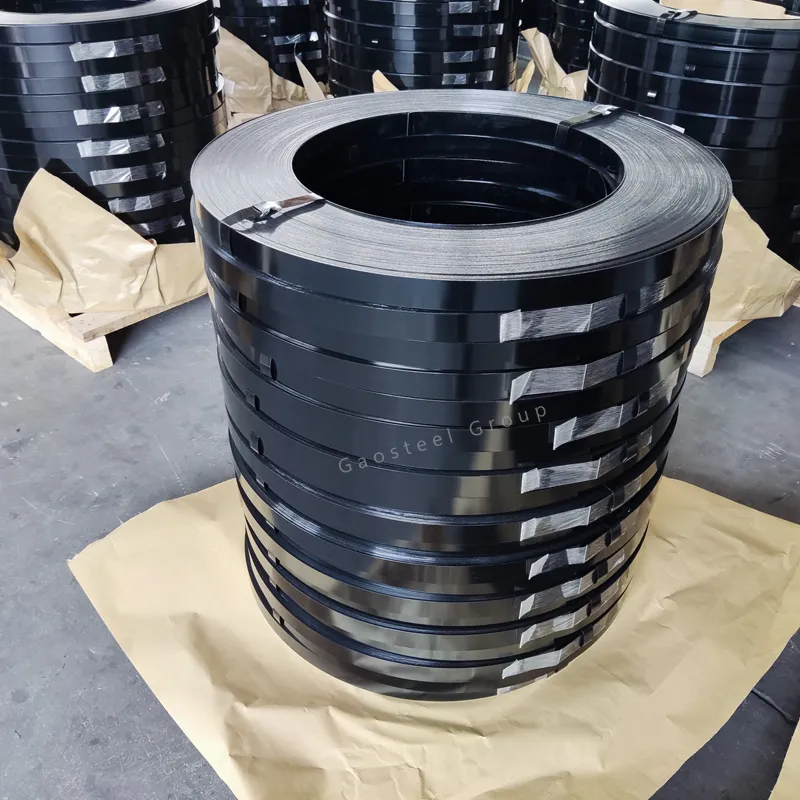
Why Black Painted Steel Strapping Introduces Unique Safety Risks
Black painted steel strapping is widely used for its cost-effectiveness and clean appearance, but its coating introduces hidden hazards that differ fundamentally from bare or galvanized steel. The paint layer obscures material degradation, rendering standard visual inspection unreliable and increasing the risk of sudden, catastrophic failure.
Corrosion concealment: How black paint masks rust, pitting, and tensile degradation
Unlike galvanized or uncoated strapping—where corrosion appears as visible orange-brown rust—black paint conceals early-stage degradation such as micro-pitting, surface scaling, and internal tensile loss. A strap may appear fully intact while its breaking strength has already fallen below safe thresholds. Industry findings confirm that hidden corrosion causes unpredictable reductions in breaking force, often resulting in snap during tensioning or transit. Because color change is suppressed, visual checks alone are insufficient. Instead, tactile evaluation—including controlled bending at multiple points to detect stiffness loss—is essential to identify internal fatigue. Additionally, the paint impedes moisture evaporation, extending exposure time and accelerating subsurface corrosion. By the time rust bleeds through the coating, structural integrity may be critically compromised.
| Inspection method | Bare steel (visible rust) | Black painted steel (hidden corrosion) |
|---|---|---|
| Visual check | Effective — rust signals degradation | Poor — coating masks early signs |
| Bend / torque test | Supplementary | Essential — stiffness loss is key cue |
| Detection lag | Minimal — immediate warning | Delayed — failure risk increases undetected |
Increased snap-back energy: Recoil forces up to 450 ft-lbs due to surface friction and delayed failure cues
The smooth, low-friction surface of black painted strapping alters failure dynamics under tension. When cut or overloaded, the paint layer can flake at the break point, momentarily reducing resistance and releasing stored energy more violently than bare steel. This can generate snap-back forces reaching up to 450 ft-lbs—comparable to the kinetic energy of a heavy impact tool. Critically, because the paint masks early warning signs like micro-cracking or localized thinning, operators receive no audible, visual, or tactile cue before failure. This delayed failure pattern makes black painted strapping especially hazardous in high-tension applications, such as securing heavy equipment or steel coils. Standard hand placement and safety distances are often inadequate; instead, controlled tension release—mechanically relieving load before cutting—is required to mitigate recoil risk.
Safe Handling and Cutting Procedures for Black Painted Steel Strapping
Safe handling and cutting of black painted steel strapping demand specific techniques tailored to its spring-loaded energy storage and concealed corrosion risks. Two core procedures—controlled tension release and precision cutting—significantly reduce snap-back injury potential.
Controlled tension release: The 3-second rule and mechanical relief best practices
After tensioning, operators must apply the “3-second rule”: hold the tensioner in place for three full seconds before disengaging. This brief pause allows residual elastic energy to dissipate gradually rather than explosively. For mechanical relief, use a tensioner with a controlled-release lever or ratcheting system that enables incremental load reduction. Never cut a strap while under full tension—always relieve at least 80% of the load by slowly loosening the tensioner first. This prevents the violent whipping motion responsible for recoil forces up to 450 ft-lbs.
Mitigating cutting slippage: Tool selection, blade geometry, and surface-condition awareness
Cutting black painted steel requires tools engineered for hardened strapping—not general-purpose wire cutters. Select models with fine serrated edges or carbide-tipped blades designed to grip slick, painted surfaces without sliding. Because the paint creates a lubricating film, inspect jaw alignment before each cut to ensure contact with bare metal where possible. Use a two-handed compound-lever cutter to maximize force application and minimize jerking. Apply steady, even pressure at a precise 90-degree angle—never twist mid-cut. Be alert to surface chips or flaking paint, which indicate areas where blade traction may suddenly fail.
PPE Requirements Specifically Validated for Black Painted Steel Strapping
Face shields + ANSI Z87.1+ high-impact goggles: Essential for snap-back debris protection
When black painted steel strapping fails, it releases high-velocity debris—including paint fragments, rust particles, and sharp metal shards—at speeds exceeding the protective capacity of standard safety glasses. Face shields alone leave vulnerable gaps beneath the chin and around the temples; goggles alone omit forehead and neck coverage. The validated industry standard is layered protection: an impact-rated face shield worn over ANSI Z87.1+ high-impact goggles. This combination provides full facial coverage against unpredictable recoil events—particularly critical given that painted surfaces hide corrosion weak points, eliminating reliable visual failure warnings.
ANSI A9+ cut-resistant gloves with reinforced thumb crotch: Addressing sharp painted edges and micro-abrasions
Standard leather or knit gloves offer negligible resistance against the razor-sharp edges of black painted steel strapping. The paint layer can delaminate into abrasive micro-particles that embed in glove fibers, while the underlying steel generates deep lacerations. Gloves must meet ANSI A9+ cut resistance and feature a reinforced thumb crotch—the area most stressed during tensioning and cutting—to prevent punctures and lacerations caused by hidden burrs and edge irregularities masked beneath the coating.
Inspection, Maintenance, and Load-Securing Verification for Black Painted Steel Strapping
Dual-mode inspection: Visual cues + tactile torque/bend testing to detect under-paint corrosion
Visual inspection alone is ineffective for black painted steel strapping, as the coating hides rust, pitting, and tensile degradation. Reliable assessment requires dual-mode evaluation: combine visual scanning for blistering, chipping, or discoloration with tactile torque and bend testing. Apply moderate rotational force along the strap to detect unexpected flex or torsional give, and bend sample sections at multiple intervals to identify brittle zones or abnormal resistance. These methods expose subsurface damage before it compromises performance. For final load-securing verification, confirm tension values using calibrated tools—and replace any strap raising uncertainty. Consistent dual-mode inspection is the only proven method to maintain long-term safety and structural reliability.
FAQ
1. Why is black painted steel strapping more hazardous than galvanized or bare steel?
Black paint hides early signs of corrosion and tensile degradation, making visual inspections unreliable. It also increases the potential for violent recoil forces upon failure.
2. What inspection methods are recommended for black painted steel strapping?
Use a combination of visual inspection and tactile evaluations, including torque and bend testing, to identify hidden corrosion and degradation.
3. What tools should be used for cutting black painted steel strapping?
Specialized tools with serrated or carbide-tipped edges are recommended to grip the slippery painted surfaces effectively.
4. How can snap-back energy be mitigated during tension release?
Always follow the 3-second rule and use mechanical release tools to slowly reduce tension before making cuts.
5. What PPE is essential for working with black painted steel strapping?
Operators should wear layered protection: ANSI Z87.1+ goggles combined with an impact-rated face shield and ANSI A9+ cut-resistant gloves.
6. Can black painted steel strapping be safely inspected visually?
Visual inspection alone is insufficient due to the paint's ability to conceal defects. Tactile methods must complement visual checks.