EN
EN



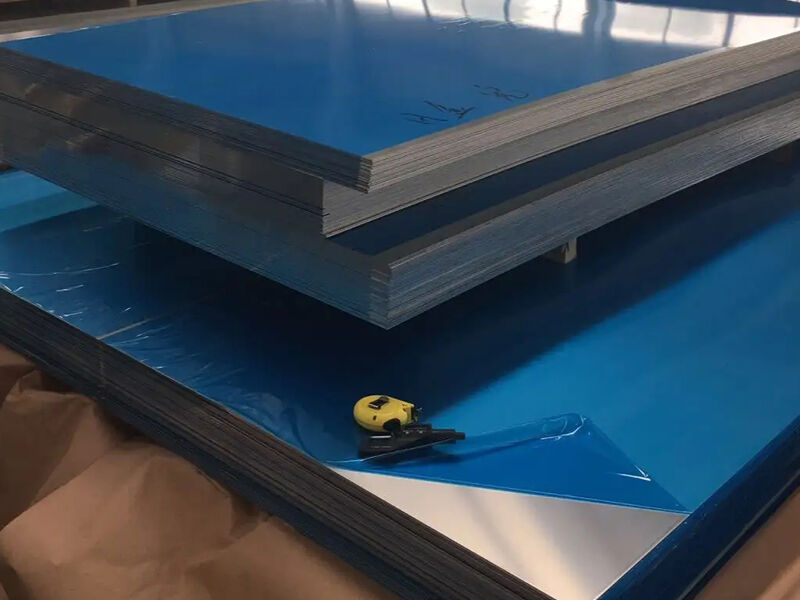
Superior Corrosion Resistance in Demanding Industrial Environments
Self-healing Oxide Layer and Performance in Chemical, Marine, and Acidic Settings
Aluminum sheets naturally form a nanoscale, self-repairing oxide layer that reforms within milliseconds when scratched or abraded. This passive barrier effectively blocks chloride ions in marine environments, acidic process chemicals, and airborne industrial pollutants—outperforming uncoated carbon steel in long-term exposure. Marine-grade aluminum alloys, particularly 5083 and 6061, retain structural integrity for over 20 years in tidal splash zones, whereas carbon steel typically fails within five years under equivalent ASTM B117 accelerated salt-spray conditions.
Real-World Validation: Offshore Platforms, Chemical Processing Tanks, and Coastal Infrastructure Using 5083 and 6061 Aluminum Sheets
Field performance confirms laboratory findings: 5083-H116 is the alloy of choice for offshore platform walkways and ship hulls due to its exceptional resistance to saltwater pitting and stress corrosion cracking. Meanwhile, 6061-T6 reliably contains sulfuric and phosphoric acid vapors in chemical processing tanks. A decade-long monitoring study of coastal bridge cladding found maximum material loss of just 0.1 mm—demonstrating durability where corrosion-related infrastructure failures cost an estimated 3–5% of global GDP annually.
Exceptional Strength-to-Weight Ratio for Efficient Structural Design
Comparative analysis: 6061-T6 aluminum sheets vs. A36 steel — yield strength per kg/m³ and implications for load-bearing structures
Aluminum sheets deliver transformative structural efficiency through their unmatched strength-to-weight ratio. 6061-T6 aluminum, with a density of 2.7 g/cm³ (versus A36 steel’s 7.85 g/cm³), achieves a yield strength-to-density ratio of 89–100 MPa·m³/kg—nearly three times higher than A36 steel’s 32 MPa·m³/kg. Though absolute yield strength is comparable (240–270 MPa vs. 250 MPa), the dramatic weight reduction enables lighter, more agile frameworks without sacrificing safety margins. In bridge design, aluminum substitution cuts dead load by 50–65%, extending viable span lengths and simplifying erection logistics. Key comparative metrics are summarized below:
| Property | 6061-T6 Aluminum | A36 Steel | Advantage Factor |
|---|---|---|---|
| Density (g/cm³) | 2.7 | 7.85 | 2.9× lighter |
| Yield Strength (MPa) | 240–270 | 250 | Comparable |
| Strength/Weight (MPa·m³/kg) | 89–100 | 32 | 2.8–3.1× higher |
Logistical and economic benefits: Reduced shipping costs, easier handling, and lower foundation requirements
The weight advantage translates directly into operational savings. Transporting aluminum sheets reduces freight volume and cost by 30–40% compared to equivalent-strength steel shipments. On-site handling improves significantly—fabricators report up to 20% faster installation on high-rise and modular projects due to manageable component weights. Foundation loads decrease proportionally, requiring 15–25% less concrete and reinforcing steel. Lifecycle analysis from a 2023 industry benchmark study shows aluminum sheet-based buildings save approximately $740,000 in transport and $1.2 million in foundation costs per 10,000 m²—validating its role as both a high-performance and economically intelligent structural material.
Outstanding Formability and Fabrication Flexibility Across Aluminum Sheets
Cold-forming capabilities by alloy series (3xxx, 5xxx, 6xxx): bend radius limits, springback control, and stamping precision
Aluminum sheet alloys offer distinct, application-tailored formability. The non-heat-treatable 3xxx series (e.g., 3003) achieves tight bend radii down to 0.5t (half the material thickness) with minimal risk of edge cracking—ideal for deep-drawn enclosures. 5xxx alloys like 5052 excel in springback control during high-speed stamping, delivering repeatable dimensional accuracy critical for automotive body panels. Heat-treatable 6xxx grades—including 6061—maintain excellent shape retention after bending and machining, supporting complex geometries with tolerances under ±0.1 mm without intermediate annealing.
Enabling advanced manufacturing: Ultra-thin foil production (<0.2 mm) and high-tolerance sheet metal fabrication
Aluminum’s workability underpins next-generation manufacturing. Continuous cold-rolling produces ultra-thin foils as thin as 0.006 mm—used in lithium-ion battery current collectors and pharmaceutical packaging. High-purity 1xxx-series sheets support micro-milling and photochemical etching for aerospace components demanding ±0.025 mm precision. Its high electrical conductivity also enables electromagnetic forming (EMF), achieving up to 20% greater deformation limits than conventional stamping—allowing single-step fabrication of intricate fuel cell bipolar plates and heat exchanger cores.
Sustainability Leadership: Recyclability and Lifecycle Efficiency of Aluminum Sheets
Closed-loop recycling: 95% energy reduction vs. primary production and global adoption in green industrial standards
Aluminum sheets exemplify circular material science: they are infinitely recyclable without any loss of mechanical or metallurgical properties. Recycling post-consumer or post-industrial scrap requires only 5% of the energy used in primary production—a verified 95% energy reduction according to the International Aluminium Institute’s 2023 lifecycle assessment. This efficiency directly lowers embodied carbon and operational costs while aligning with globally recognized sustainability frameworks, including LEED v4.1, ISO 14040, and the EU Green Deal’s construction material mandates. As industries from transportation to infrastructure increasingly specify high-recycled-content aluminum sheets—often exceeding 75% recycled content—the material has become foundational to responsible, future-ready industrial design.
FAQ
Why is the self-healing oxide layer important in aluminum sheets?
The self-healing oxide layer on aluminum sheets is crucial as it provides superior corrosion resistance. It forms quickly when the surface is scratched, protecting against chemical, marine, and acidic environments.
How does aluminum compare to A36 steel in terms of strength-to-weight ratio?
6061-T6 aluminum has an almost three times higher strength-to-weight ratio compared to A36 steel, offering significant weight reduction and load-bearing efficiency in structural design.
What are the economic benefits of using aluminum sheets?
Aluminum sheets offer lower shipping costs, easier handling due to their lightweight nature, and reduced foundation requirements, leading to significant savings in logistics and construction.
Are aluminum sheets recyclable?
Yes, aluminum sheets are infinitely recyclable without loss of properties, requiring only 5% of the energy needed for primary production, greatly reducing their environmental impact.