EN
EN



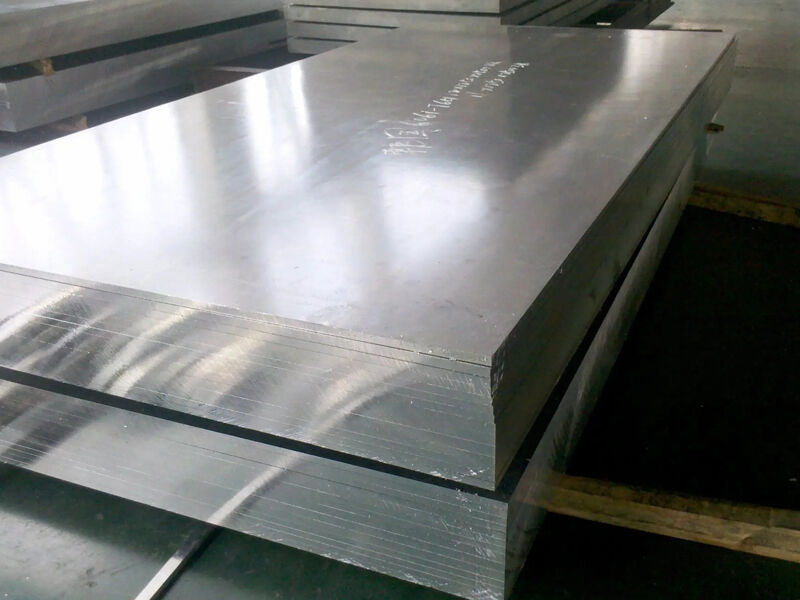
Outstanding Corrosion Resistance for Demanding Industrial Environments
Performance in Marine, Coastal, and Chemical-Exposed Applications vs. Other Non-Heat-Treatable Alloys
The 5052 aluminum sheet consistently outperforms alternatives like 3003 alloy in aggressive environments due to its optimized metallurgical composition. In marine applications, it demonstrates approximately 50% less mass loss than standard 3003 alloy after prolonged salt spray exposure per ASTM B117 testing (NACE 2023). This advantage extends to chemical processing plants, where inorganic acids cause severe pitting in non-stabilized alloys; 5052 maintains structural integrity at chloride concentrations exceeding 3,500 ppm without protective coatings. Its resilience stems from finely tuned elemental ratios—particularly its elevated magnesium content—which suppress intercrystalline corrosion and grain boundary degradation common in lower-grade alloys.
Role of Magnesium and Chromium in Stabilizing the Protective Oxide Layer
Magnesium (2.2–2.8%) and chromium (0.15–0.35%) synergistically enhance 5052’s corrosion barrier. Magnesium forms a stable β-phase (Al₃Mg₂) that slows cathodic reaction kinetics, reducing galvanic corrosion rates by up to 70% versus magnesium-free alloys (ASM Handbook 2022). Chromium promotes formation of passive Cr₂O₃ nano-layers within the native aluminum oxide film—especially effective in pH-neutral environments—raising the threshold for chloride-induced pitting. As a result, 5052 withstands over 20,000 hours in neutral salt fog tests before significant pitting occurs. Crucially, this dual-action system preserves the oxide layer’s self-repair capability even at temperatures up to 65°C (150°F), unlike surface-treated alloys that degrade rapidly under thermal stress.
Superior Cold-Forming Capabilities of 5052 Aluminum Sheet
The 5052 aluminum sheet delivers exceptional cold-forming performance essential for precision manufacturing. As a non-heat-treatable alloy, it achieves its mechanical properties through controlled strain hardening rather than thermal processing.
Optimal Balance of Strength and Ductility in H32 Temper (193 MPa YS, 12% Elongation)
In H32 temper, 5052 maintains a unique equilibrium between strength and formability: a yield strength of 193 MPa and 12% elongation enable deep deformation without cracking. This balance supports demanding fabrication processes—including deep drawing, complex stretch forming, and high-integrity structural components—where higher-strength alloys often fail due to brittleness. The magnesium content enhances strength while chromium stabilizes the microstructure during deformation, enabling reliable production of intricate geometries unattainable with competing non-heat-treatable alloys.
Controlled Work Hardening and Minimal Springback in Precision Stamping and Bending
Precision fabrication benefits from 5052’s predictable work hardening behavior. In H32 temper, it exhibits gradual strain hardening, up to 15% less springback than annealed tempers, and consistent dimensional accuracy in tight-tolerance bending. These traits allow stamped components—such as automotive trim and electronic enclosures—to hold ±0.1 mm tolerances without secondary correction. Reduced springback also lowers tooling wear and minimizes production downtime.
Reliable Weldability and Fabrication Versatility Without Post-Weld Heat Treatment
Low Hot-Crack Susceptibility and Consistent Joint Integrity in TIG/MIG Welding
5052 aluminum sheet offers exceptional weldability in both TIG and MIG processes, with low susceptibility to hot cracking—a key advantage over many aluminum alloys. Its balanced magnesium content (~2.5%) limits brittle phase formation at weld boundaries, supporting consistent joint integrity and porosity rates below 0.5% in controlled environments. Stable thermal conductivity ensures uniform heat dispersion, cutting distortion risk by up to 30% compared to heat-treatable alternatives. Because post-weld heat treatment is unnecessary, 5052 streamlines fabrication for pressure-sensitive applications—such as fuel tanks and containment vessels—where weld reliability directly impacts safety and service life.
Proven Cross-Industry Applications of 5052 Aluminum Sheet
Marine Hardware, Automotive Trim, Pressure Vessels, and Electronic Enclosures
5052 aluminum sheet delivers versatile, field-proven performance across critical sectors. In marine applications, it’s specified for boat hulls, fuel tanks, and dock hardware—leveraging its chromium-enhanced oxide layer to resist saltwater corrosion. Automotive engineers use the H32 temper for lightweight trim, floor panels, and oil lines, achieving up to 40% weight reduction versus steel while maintaining crash-resilient formability. For industrial equipment, its 12% minimum elongation and low springback support reliable fabrication of pressure vessels and chemical drums that endure cyclic loading. Electronics manufacturers select it for EMI-shielding enclosures in computers, GIS systems, and control cabinets—valuing its anodization compatibility, weld integrity, and corrosion resistance. This broad adoption reflects 5052’s rare convergence of weldability, cold-forming precision, and environmental durability.
FAQ
What makes 5052 aluminum sheet ideal for marine applications?
5052 sheet is ideal for marine applications due to its superior corrosion resistance, particularly in saltwater environments, thanks to its chromium-enhanced oxide layer.
How does 5052 aluminum compare to other alloys in terms of weldability?
5052 aluminum offers exceptional weldability with low susceptibility to hot cracking, a key advantage over many other aluminum alloys, allowing for consistent joint integrity.
Why is post-weld heat treatment unnecessary for 5052 aluminum?
Post-weld heat treatment is unnecessary due to 5052’s stable thermal conductivity and ability to preserve weld reliability without additional thermal processing.
What applications benefit from the cold-forming capabilities of 5052 aluminum?
Applications such as automotive trim, electronic enclosures, and industrial pressure vessels benefit from 5052's superior cold-forming capabilities, offering precision and durability.