EN
EN



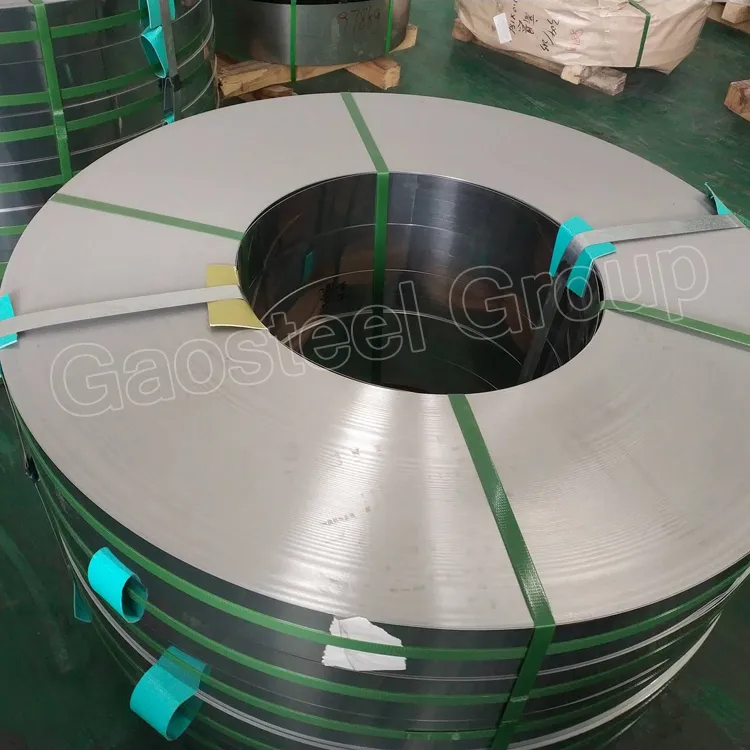
Ultra-Precise Dimensional Control in Stainless Steel Strip
Achieving Micro-Tolerance Thickness: Down to 0.0008" with ±0.5% Consistency
Modern precision engineering demands material specifications that eliminate guesswork. Advanced cold rolling processes now achieve thickness tolerances as tight as 0.0008 inches with a consistency of ±0.5%, directly enabling reliable performance in micro-electromechanical systems (MEMS), where even minor thickness variation can cause signal interference or mechanical failure. This level of control reduces rework and improves product yield across high-volume manufacturing. The process relies on closed-loop feedback systems that monitor gauge in real time and automatically adjust roll pressure—ensuring every inch of the coil meets the target specification.
How Multi-Pass Cold Rolling Refines Grain Structure and Minimizes Residual Stress
Multi-pass cold rolling delivers more than dimensional precision—it fundamentally enhances material behavior. Each incremental reduction breaks down coarse grains into a fine, uniform matrix, boosting mechanical strength and fatigue resistance. Critically, it also minimizes residual stress that can induce warping during precision machining. Tension levelers integrated between passes actively relieve internal stresses, resulting in exceptional flatness and dimensional stability—key requirements for medical implants and aerospace components. This approach consistently achieves thickness variation below 0.0001 inches, meeting the most stringent benchmarks for high-performance strip.
Comprehensive Tolerance Management Across All Critical Dimensions
Width, Flatness, and Edge Quality: Meeting DIN EN ISO 9445-1 for <±0.0001" Thickness Variation
True precision extends beyond thickness to encompass width, flatness, and edge integrity—all governed by the international standard DIN EN ISO 9445-1. Leading suppliers exceed this benchmark, delivering thickness variation under ±0.0001 inches, enabled by fully automated rolling mills with real-time metrology and adaptive control. Precision slitting ensures consistent width tolerance, preventing misalignment during stamping or high-speed forming. Flatness is maintained through tension leveling and optimized roll contouring, guaranteeing the strip lies perfectly flat for automated assembly—especially critical in electronics and medical device production.
Tension Leveling and Laser-Guided Slitting: Eliminating Coil Set and Micro-Burrs
Tension leveling permanently eliminates coil set—the residual curvature from coiling—by stretching the material slightly beyond its yield point under controlled tension, locking in dimensional stability. For final width definition, laser-guided slitting replaces conventional shear blades, delivering micron-level accuracy and eliminating micro-burrs that compromise functionality in sensitive applications like connector pins or micro-sensors. Together, these processes ensure a stress-relieved, burr-free strip with edge quality and flatness suitable for the most demanding high-speed, high-reliability manufacturing environments.
Inherent Material Performance Supporting Demanding Precision Applications
Corrosion Resistance & Fatigue Strength: 316 Stainless Steel Strip in 10M+ Cycle Medical Micro-Connectors
Grade 316 stainless steel strip combines exceptional corrosion resistance with outstanding fatigue endurance—making it ideal for implantable medical micro-connectors. Its molybdenum content significantly improves resistance to chloride-induced pitting, while tightly controlled processing yields a refined, homogeneous microstructure that suppresses crack initiation. Laboratory testing confirms reliable performance beyond 10 million bending cycles, ensuring long-term conductivity and structural integrity inside the human body without degradation.
Surface Integrity: Bright Annealing and Passive Oxide Layer Stability for Nanoscale Smoothness
Bright annealing in a hydrogen-rich atmosphere produces a scale-free, mirror-finish surface while stabilizing the passive chromium oxide layer for uniform corrosion resistance across the entire strip. This process achieves surface roughness values below 10 nm Ra, far surpassing mechanically polished alternatives—and without introducing cold-work damage. Such nanoscale smoothness minimizes friction, particle generation, and electrostatic charging, making bright-annealed 316 strip the preferred choice for cleanroom assembly of optical sensors, MEMS devices, and high-reliability medical electronics.
Real-World Adoption of Stainless Steel Strip in High-Precision Industries
Stainless steel strip is now the material of choice across multiple high-tech sectors where dimensional fidelity, surface quality, and long-term reliability converge. Automotive manufacturers use it for exhaust components, transmission parts, and corrosion-resistant trims; electronics firms rely on its stability for high-frequency connectors and microchip lead frames; medical device makers specify it for surgical tools and implantable micro-connectors; and aerospace engineers adopt it for lightweight, high-strength components that improve fuel efficiency without compromising safety. This broad adoption reflects a market poised to grow from $4.3 billion in 2024 to over $5.1 billion by 2030, driven by the material’s unique integration of micro-tolerance thickness control, nanoscale surface integrity, and consistent mechanical performance—qualities no alternative material matches at scale.
FAQ
What is the significance of thickness control in stainless steel strips?
Thickness control ensures reliable performance in applications like MEMS and high-volume manufacturing, improving product yield and reducing rework.
How does multi-pass cold rolling improve stainless steel strip properties?
Multi-pass cold rolling enhances mechanical strength, fatigue resistance, and minimizes residual stress for dimensional stability.
Why is 316 stainless steel strip ideal for medical micro-connectors?
Grade 316 stainless steel offers exceptional corrosion resistance, fatigue endurance, and maintains structural integrity over 10 million bending cycles.
How does bright annealing contribute to surface integrity?
Bright annealing achieves a nanoscale smooth, mirror-like surface and stabilizes the passive oxide layer for uniform corrosion resistance.
What industries widely adopt stainless steel strips?
Stainless steel strips are utilized across automotive, electronics, medical devices, and aerospace industries for their precision and durability.
Table of Contents
- Ultra-Precise Dimensional Control in Stainless Steel Strip
- Comprehensive Tolerance Management Across All Critical Dimensions
- Inherent Material Performance Supporting Demanding Precision Applications
- Real-World Adoption of Stainless Steel Strip in High-Precision Industries
-
FAQ
- What is the significance of thickness control in stainless steel strips?
- How does multi-pass cold rolling improve stainless steel strip properties?
- Why is 316 stainless steel strip ideal for medical micro-connectors?
- How does bright annealing contribute to surface integrity?
- What industries widely adopt stainless steel strips?